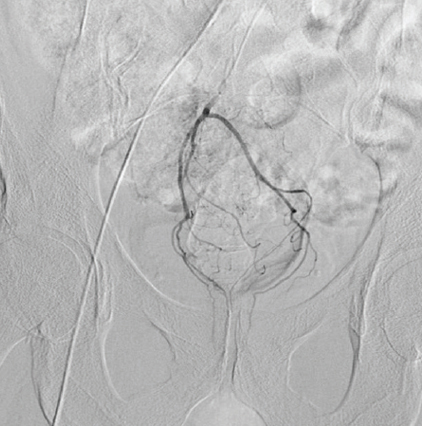
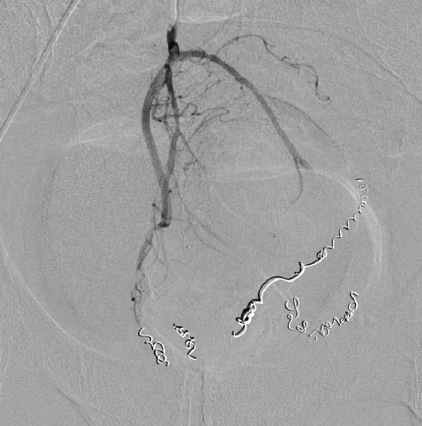
Hemorrhoids are a common anorectal disease that affects millions of people worldwide and are a major medical and socioeconomic problem. Internal hemorrhoids are composed of a dense anastomotic arteriovenous network, the corpus cavernosum recti (CCR). The CCR is dependent on the influx of arterial blood from the branches of the inferior mesenteric artery (the superior rectal arteries (Figure 1 and Figure 2). The lower part of the rectum and the anal canal are supplied with blood by the inferior and middle rectal arteries, both of which have origins from the internal iliac artery.
The replacement of muscle tissue with connective tissue causes an expansion of this vascular network of the anorectal submucosa, initiating a negative vicious cycle of progressive vascular dilation and venous insufficiency leading to hemorrhoidal hyperplasia, which in turn causes an increase in arterial inflow in the CCR and leads to symptoms.
Chronic bleeding is the primary symptom of internal hemorrhoids and could be associated with hemorrhoidal prolapse. It is widely accepted that it is difficult for patients to assess bleeding themselves, and assessment is even more difficult in this context, due to the intermittent nature of hemorrhoidal bleeding.
Treatment-hemorrhoidal artery embolization, termed the hemorrhoid technique. This technique involves endovascular coil occlusion of the distal branches of the SRA arising from the inferior mesenteric artery. This technique has several advantages: it leaves the hemorrhoidal tissue in place, preserves anal continence, and does not involve the creation of rectal wounds (no local care required).